
If you’re ready to move from a basic sugar wash and craft a truly high-quality American style bourbon sprit this recipe is just for you.
Based around a 58.8% corn backbone enriched with rolled oats for a silky mouthfeel and 80L Caramel Malt for a warm, toasted-sugar finish, this mash will give you a sweet, full-bodied distillate that ages beautifully in oak.
Here is the exact mash bill, step by step cook process and a sensory cut guide based on data from real runs I’ve made.
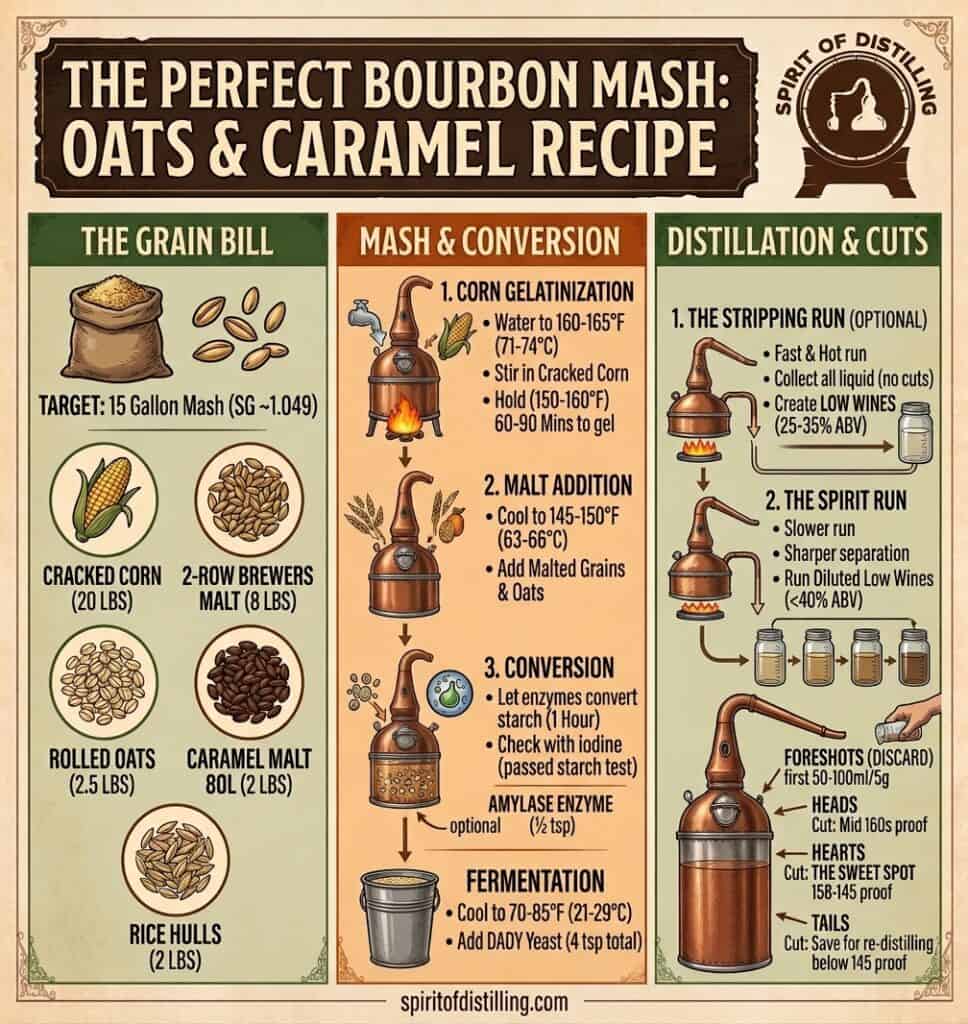
The Recipe & Ingredients
I split this between 2 fermenters, but if your fermenter is large enough for the full 15 gallon batch go for it.
Target Batch Volume: 15 Gallons
Target Starting Gravity: 1.049
Actual Yield SG: ~1.041 – 1.044
Final Gravity: 1.004
The Mash Bill
| Ingredient | Weight / Amount | Bill % | Purpose |
| Cracked Corn | 20 lbs | 58.8% | Primary bourbon base (coarse/medium grind) |
| Briess 2-Row Brewers Malt | 8 lbs | 23.5% | Diastatic power & fermentable sugars (fine grind) |
| Rolled Oats | 2.5 lbs | 7.4% | Creamy mouthfeel & head retention |
| Briess Caramel Malt 80L | 2 lbs | 5.9% | Rich caramel color, body, & aroma (fine grind) |
| Rice Hulls | 2 lbs | 4.4% | Lautering aid to prevent stuck mashes |
Additions
- Water: ~8.5 Gallons initial mash water + sparge water
- Enzymes: ½ tsp High-Temp Amylase Enzyme (optional insurance)
- Yeast Nutrients: 4 tsp total (2 tsp per 25L fermenter)
- Yeast: 4 tsp Red Star DADY (Distillers Active Dry Yeast) split across two fermenters
Step-by-Step Mash & Brew Day Schedule
Phase 1: Gelatinizing the Corn
Corn starches are locked in the grain and need to be opened up to allow the enzymes to reach them. This is done by gelatinizing the corn at high temperature. If you have a large brew kettle or electric brewing system this can be easily done, I used an insulated mash tun and followed the following process.
- Initial Mash-In: Add 20lb of ground cracked corn to 3.75 gallons of boiling water. Temperature should settle around 138°F (59°C).
- Step Heat: Add an additional 2.75 gallons of boiling water to bring mash temperature to around 168°F (73°C). Cover and stir occasionally
- Step Heat Again: Once the temperature drops below 140°F (60°C) add and additional 2 gallons of boiling water temperature will reach about 175°F (79°C). Cover stirring occasionally again until your mash time reaches about 1.5 hours.
Phase 2: Saccharification (Malt Conversion)
- Cooling to Conversion Temperature: Once the cooked corn temperature drops to 154°F (68°C) stir in the 8 lbs of 2-Row Malt, 2 lbs of Caramel Malt, and 2.5 lbs of Rolled Oats. The addition of room temperature malts should drop the mash temperature to the target range of 145-150°F (63-65°C)
- Enzyme Rest: Hold the mash at 145-150°F (63-65°C) for 60 to 90 minutes to allow the enzymes in the malted barley to convert the grain starches to fermentable sugars. Stir occasionally during this time.
- Starch Test: Perform and iodine test by removing a small amount of the mash liquid putting it on a white plate, cup or bowl and add a drop of iodine. If it stays dark black the starch has not fully converted, but if it turns light brown and dissipates you are ready to move on. If you don’t have full starch conversion a ½ tsp of Alpha-amylase enzyme can be added to ensure full starch conversion.
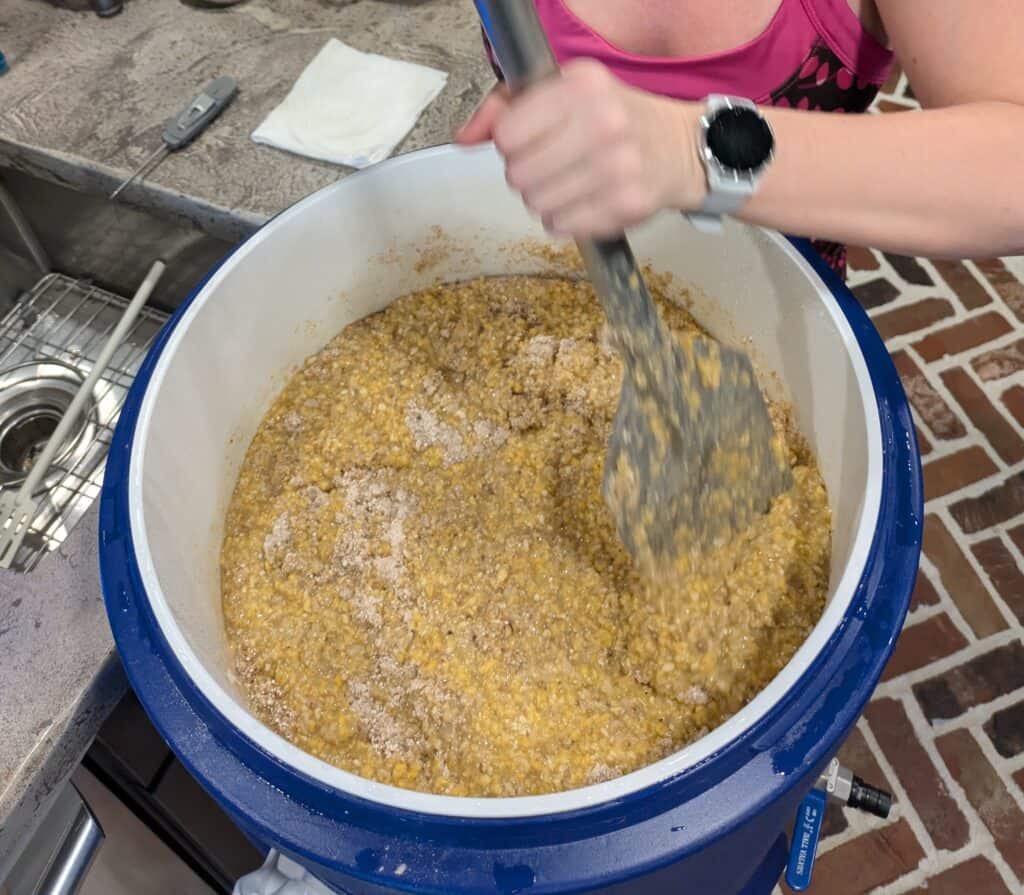
Phase 3: Lautering, Sparging and Pitching
- Lautering: Stir in 2 lbs of rice hulls. This will create channels in the grains for the liquid to flow through. Drain the liquid into your fermenter, if using 2 fermenters alternate between them to keep a consistent SG. Add water and continue rinsing the grains until you reach about 13 gallons (50L).
- Yeast Nutrient and PH: Check the pH (target about 5.0 – 5.5 and add citric acid if needed to reduce the ph). With the pH correct, add 4 tsp of yeast nutrient.
- Cool and Pitch Yeast: Allow the mash to cool to 70-85°F (21-29°C). Pitch 4-6 tsp of DADY yeast (or the yeast of your choice).
💡 Fermentation Note: Expect a healthy, vigorous conversion. With an initial SG around 1.041–1.044, DADY yeast will clean out fermentable sugars down to 1.004 within 6 to 7 days.
Distillation Options: Single Run vs Double Distillation
You can perform a careful single run from your cleared wash and get a good result, but performing a double distillation is the best way to get the refined, high-quality bourbon you really want.
- Step 1: The Stripping Run (Optional but recommended): Run your clear wash as fast and hot as your still will allow without puking, scorching or pushing vapor all the way through your condenser. Collect everything down to 15-20% ABV (30-40 Proof). The goal is to strip the water solids and heavy proteins out of the alcohol to produce low wines (typically around 25-30% ABV).
- Step 2: The Spirit Run: Charge your still with your low wines (always diluted below 40% ABV for safety). Run a second distillation slow and steady as described in the next section. Double distillation cleans up some of the harsh flavors and concentrates the rich flavors we are looking for. Take your time to make clean cuts between heads, hearts and tails.
Distillation and Cuts: Adapted from my experience and Alan Bishop’s theory
When running your spirit run, relying on proof cuts yields a balanced, traditional bourbon profile:
- Foreshots: Discard the initial 50–100 mL per 5 gallons of wash to remove volatile compounds.
- Heads Cut: Collect through the high-proof initial phase; heads typically transition in the mid-160s proof.
- Hearts Cut (The Sweet Spot): Collect your main drinking spirit between 158 proof down to 145 proof. This narrow band captures the sweet caramel, smooth oat body, and corn warmth while leaving behind heavy, oily tail compounds.
- Tails Cut: Switch collection vessels below 145 proof to save for future low-wines runs.
Recommended Reading & Tools
- Want to review how to identify cuts by taste and smell? Read our guide on Understanding the Science of Cuts.
- Debunking safety rumors? Read our guide on Will Methanol in Moonshine Make You Go Blind?.
- New to home distilling? Check out our list of recommended equipment in The Complete Home Distiller’s Starter Kit.