
If you talk to a group of home distillers about their process and what makes a good spirit each one will have something different to say about their mash bill, the yeast they use or how to age a whiskey. But if you ask them what separates a harsh headache inducing moonshine from a quality top-shelf craft spirit, they will all say the same thing, It’s making the right cuts.
Home distilling really isn’t about making alcohol – the yeast takes care of that part during fermentation. Distillation is the process of separating compounds by their boiling points.
When you heat a mash in your still, compounds vaporize and move through the head or column before condensing and dripping into a collection jar. This process happens in a predictable sequence and knowing how to identify the phases of this process namely – Foreshots, Heads, Hearts and Tails – is probably the most important skill you can develop as a home distiller.
The following guide will help you understand the science of cuts and how to identify each phase using taste, smell and temperature to make perfect cuts and blend like a master distiller.
The Chemical Sequence: What Happens Inside the Still?
A fermented wash or distillers beer doesn’t just contain water and ethanol. It contains a mixture of other alcohols, esters, aldehydes and fusel oils, and each of those components has its own boiling point.
- Acetone / Volatiles: Boil early at lower temperatures.
- Ethanol: Boiling point around 173.1°F (78.4°C).
- Water: Boiling point at 212°f (100°C).
- Fusel Oils / Heavy Alcohols: Boil off at higher temperatures near water’s boiling point.
Since these different boiling points evaporate at different times and temperatures during the run the drips coming off the still are constantly changing from the first drip until you shut the run down.
The 4 Phase of a Distillation Run
There are usually 4 phases referred to when talking about distillation. Let’s break down each of those phases.
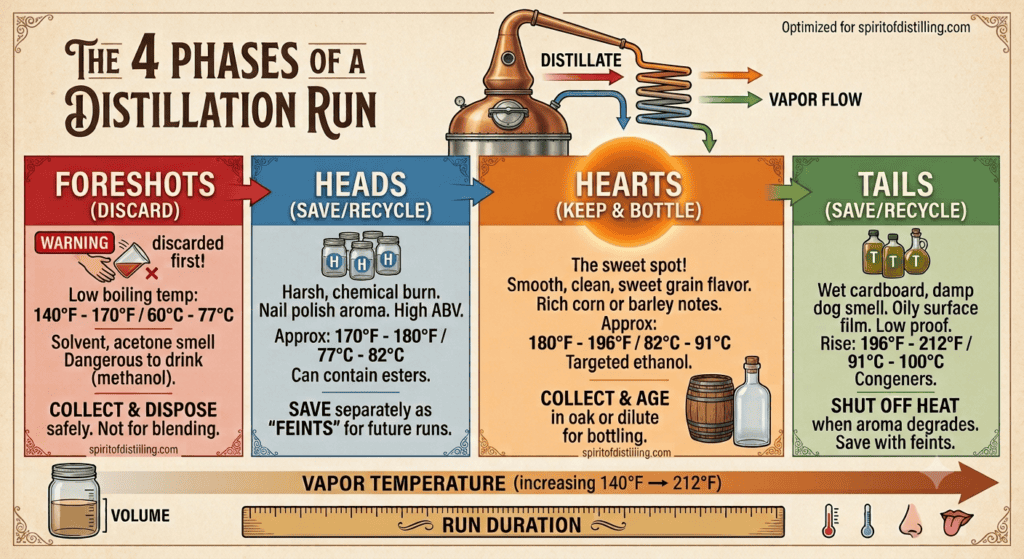
1. The Foreshots (Not for Drinking!)
The first vapor to condense and drip from the still contains the most volatile compounds like acetone, ethyl acetate and small amounts of methanol.
- Vapor Temperature: Starts around 140°F – 170°F (60°C – 77°C).
- Aroma & Taste: Smells like solvent of rubbing alcohol. Never drink Foreshots!
- Rule of Thumb: Discard the first 50-100mL of distillate per 5 gallons (19 liters) of wash. Fruit mashes produce slightly more volatile compounds, and you should take a bigger foreshots cut 100-150mL per 5 gallons.
2. The Heads (The Sharp and Harsh Phase)
As the foreshots end the run moves to Heads. This part of the run contains more ethanol but it is mixed with other volatile compounds like acetaldehyde. Blending this in with your finished product is a great way to get a headache after a night of drinking.
- Vapor Temperature: Starts around 170°F – 180°F (77°C – 82°C).
- Aroma & Taste: Smells like acetone or nail polish remover. It has a very high ABV but has a sharp bite on the tongue.
- What to do with it: Collect heads into separate jars. Heads contain to many unpleasant compounds to drink, but can be save as “Feints” to re-distill in another run.
3. The Hearts (The Good Stuff)
This is the Sweet Spot of distilling. Hearts are the purest ethanol with a pleasant blend of flavors carried over from the grain, fruit or sugar you used as the base of your mash.
- Vapor Temperature: Starts around 180°F – 196°F (82°C – 91°C).
- Aroma & Taste: Clean, warm and smooth. Heads carry the grain notes of the corn, malted barley, molasses and fruit without a strong chemical burn.
- What to do with it: This is the part of the run you will keep and proof down with water to drink or put on oak to age to perfection.
4. The Tails (The Heavy & Oily Finish)
By this point in the run most of the ethanol has vaporized and you are reaching the boiling point of water. As the water vaporized it carries over heavier oily compounds called fusel oils or congeners.
- Vapor Temperature: Starts around 196°F – 212°F (91°C – 100°C).
- Aroma & Taste: Smells like wet cardboard or a wet dog. Some people compare tails to stale water with a very earthy smell and taste. The deeper into tails you get the more likely you are to see oils floating on top of the jar or a cloudy appearance.
- What to do with it: Tails can also be saved in your Feints jar to be run again. Adding them to your next run of the same spirit will help with consistency of flavor.
How to Make Cuts Like a Pro: The Jar Method
Determining exactly when the distillate dripping from your condenser changes from Heads to Hearts or Hearts to Tails can be frustrating and difficult for a new distiller. Instead of trying to get it perfect on your first try the Jar Method:
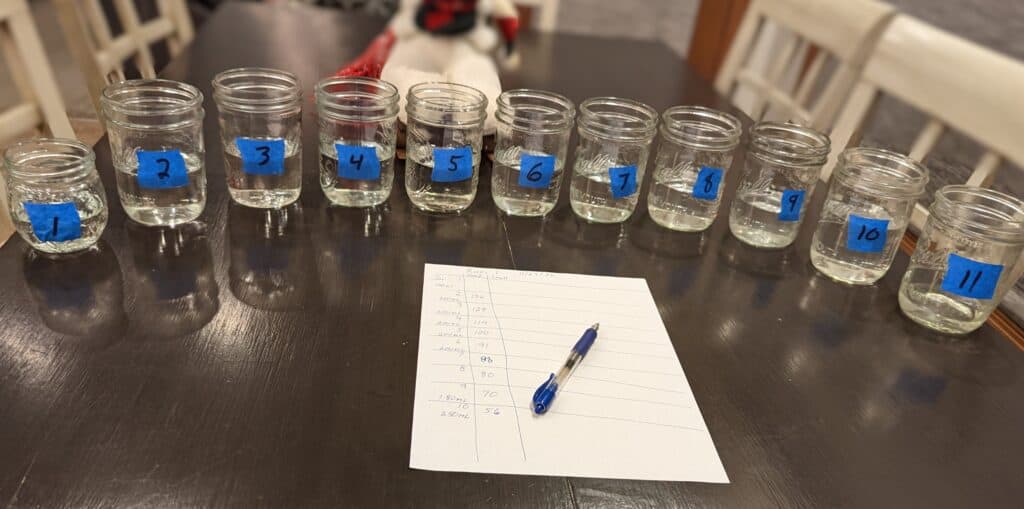
- Line up a collection of jars: Get about 12 jars and number them 1,2,3,… until you have them all numbered.
- Collect in Small Fractions: Rather than try to fill one large vessel, start collection in small amounts across your run. Use smaller jars first or only fill them 1/2 way and then switch to full jars. As you get close to the tails temperatures discussed above, start filling half jars or switch smaller jars. Make sure to number each jar in the order you collect it.
- Cover and Wait: I know it can be tempting to blend right away, but covering the jars with paper towel or a coffer filter an letting them air out overnight will give the most volatile gasses a chance to escape.
- Evaluate the Next Day: The next day smell and taste each jar. Start in the middle of the run where you are sure to get hearts. Then work down to the tails and up to the heads. As you move into the higher proof heads you may want to dilute your tastes from the jar 50/50 with water so you don’t destroy your palate you could use a large spoon or a shot glass. Take notes to help you remember. I like to slide the jars that like towards me and the other back away to visually see where I’m at.
- Blend: Pour the smooth clean tasting jars together into a larger glass container to proof down or age. You can make test blends in a glass if you want to experiment before committing. For whiskey or aged spirits a little bit of the tails is common in the final blend. The flavor will mellow and change over time as ages.
Summary Checklist
| Phase | Distilling Temp Range | Key Characteristics | Action |
| Foreshots | 140°F – 170°F | Solvent, acetone smell | Discard immediately |
| Heads | 170°F – 180°F | Chemical burn, sharp aroma | Save for Feints Run |
| Hearts | 180°F – 196°F | Smooth, clean, sweet grain flavor | Keep for Bottling / Aging |
| Tails | 196°F – 212°F | Oily, wet cardboard aroma | Save for Feints Run |
Final Thoughts
A thermometer and hydrometer are both great tools to help clue you in on where you are in a run, but your nose and palate are the real decision makers. Taking your by collecting small fractions of the run using the jar method will train your senses to pickup on the exact point where the transitions happen and grow your ability as a distiller and blender.
If you have any questions or something was unclear drop a comment below!
Happy Distilling!