
If you mention home distilling to anyone who isn’t in the hobby or a professional distiller one of the first responses you get is “Moonshine can make you go blind”.
This seems to be common knowledge passed down for generations, but is it true? Can you really go blind from a bad batch of moonshine or is it just an old wives’ tale or government conspiracy from the days of prohibition?
The simple answer is: Properly made grain spirits or sugar moonshine will not make you go blind. The longer answer is that the science behind the myth of methanol blindness and understanding foreshots is something every distiller should understand.
Here’s the real story behind methanol, blindness and moonshine safety.
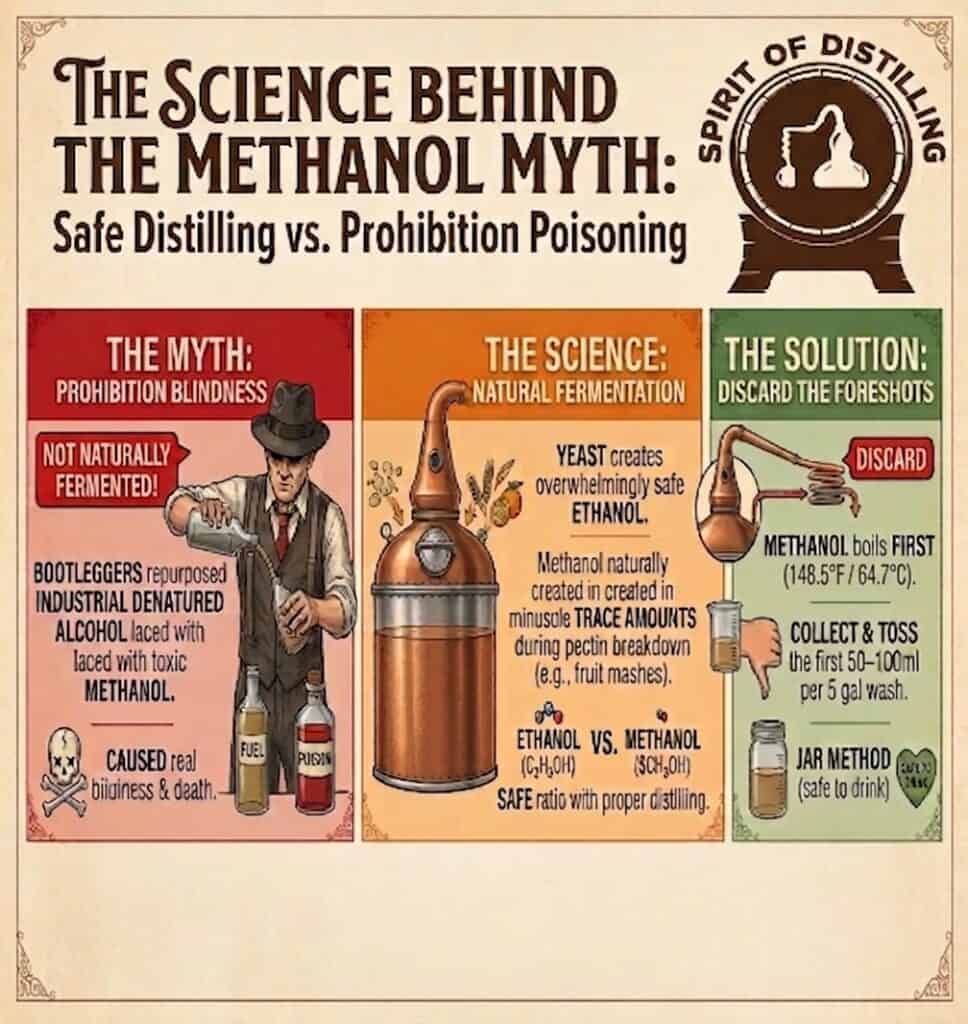
The Origins of the Myth: Prohibition & Poisoned Alcohol
The fear of being blinded by bad moonshine dates back to the Prohibition era (1920-1933).
During Prohibition moonshines and bootleggers couldn’t easily get large quantities of sugar and fermentable grains without attracting the attention of law enforcement. This led some less than honorable producers to turn to industrial denatured alcohol – alcohol that was intended for industrial paint solvents, fuel or medical use. These industrials alcohols were intentionally “spiked” with toxic chemicals (including methanol) to deter people from drinking them.
The innovative moonshiners thought they could re-distill these industrial chemicals and convert them into liquor. Unfortunately, most of the time those chemicals weren’t completely removed and many people suffered from health consequences ranging from headaches to organ damage, blindness, and in some cases, death.
The blindness was not caused by a bad fermentation or distillation – it was caused by poisonous industrial chemicals that were intentionally added by criminal moonshiners and bootleggers.
Where Does Methanol Actually Come From?
Methanol (CH3OH) is a naturally occurring simple alcohol. It is created primarily when pectin – a structural compound found in plant cell walls – breaks down.
- Fruit Mashes (High Pectin): Apples, peaches plums and grapes all contain high pectin levels. This results in higher natural production of methanol during fermentation.
- Grain & Sugar Mashes (Low Pectin): Corn, barley, wheat and cane sugars contain almost no pectin. This results in only trace amounts of methanol during fermentation.
The key takeaway: Yeast cannot create pure methanol. Yeast’s main job is to breakdown sugars into ethanol (C2H5OH). Even in a fruit mash with higher amounts of pectin the ratio of ethanol to methanol is overwhelmingly one sided with ethanol being the clear winner. Consider the fact that millions of people drink wine fermented from grapes and they aren’t going blind.
How Methanol Affects the Body (And Surprise! Ethanol is the Antidote)
Methanol does not directly cause blindness. The danger occurs after it is consumed, when the human liver metabolizes methanol with an enzyme called alcohol dehydrogenase (ADH), breaking it down into formaldehyde and then to formic acid. It’s the toxic formic acid that attacks the optic nerve, which can lead to blindness or systemic toxicity.
Fun Fact: the standard treatment in an emergency room for methanol poisoning is to administer pure ethanol.
So how does ethanol act as the antidote? It’s a process called competitive inhibition:
- Ethanol has a higher Affinity: The ADH enzyme in the liver prefers ethanol over methanol by about 10 to 20 times.
- Blocking Toxins: When ethanol is present in your bloodstream the ADH enzymes process it instead of the methanol. This prevents the methanol from getting broken down into the toxic formic acid.
- Safe Elimination: Because the methanol isn’t metabolized it gets slowly excreted through your breath and in urine without ever causing damage.
Because a natural unadulterated liquor mash contains huge amounts of ethanol compared to the tiny amount of methanol, the ethanol in your home distilled spirit acts as a buffer protecting from methanol poisoning.
The Role of Foreshots: Why Distillers Discard the First Cut
A grain mash cannot produce dangerous levels of methanol, but that doesn’t stop distillers from taking steps to improve the safety of their spirits, this is done by discarding foreshots.
Methanol boils at 148.5°F lower than that of ethanol (173.1°F). Other volatile compounds like acetone also boil at lower temperatures and come off the still at the beginning of a run.
By collecting and discarding the first 50-100ml of distillate per 5 gallons of wash, you eliminate the concentrated volatiles before they become part of your final blend.
💡 Want to dive deeper
Check out our complete guide to identifying temperatures and sensory cues during a run? : Understanding the Science of Cuts: Foreshots, Heads, Hearts, and Tails.
Safety Rules Every Distiller Should Follow
- Never Drink Denatured of Industrial Alcohol: Never try to distill or clear hardware store solvents, rubbing alcohols, or industrial liquids.
- Always Discard Foreshots: Toss the fist couple of ounces of every batch no matter the recipe or how good you think it is.
- Avoid Unknown Additives: Stick to natural grains, sugars, fruits and yeast. Never add chemicals or non-food-grade ingredients to boost the proof of your product.
- Use Food-Grade Equipment: Ensure your still, copper mesh and collection jars are food-grade stainless steel, copper or glass to avoid lead or other toxic chemicals from leaching into your product.
The Bottom Line
Can home-distilled moonshine cause you to go blind? No, not if you are distilling a “clean” wash from grain, fruit or sugar and are discarding your foreshots.
The tragic stories of blindness from moonshine should only be found in history books from Prohibition-era industrial poisoning and dangerous criminal bootleggers. By making proper washes, using the correct food-grade equipment, and making good cuts you can create smooth, safe and great tasting spirits at home.
What do you think?
Have you ever had to explain to your friends or family why they won’t go blind drinking your spirits? Drop your thoughts or questions in the comments below!